Martin Chemnitz on Rites and Ceremonies
 The following passages show with what spirit the public gatherings of
the church were to be approached and how the people were to behave in them: 1
Cor. 11:17; Matt. 18:20; 1 Cor. 5:4; Lev. 26:2; Is. 1:13; 1 Cor. 14:26,40. The
words of the Decalog teach us that the soul must be called away from all other
concerns and give itself entirely over to the public divine services. In Matt.
18:20 Christ repeats the promise given in Ex. 25:8 and Ezek. 37:26, “I will be
in the midst of them and I will hear.” In 1 Cor. 14:24-25: “A person who comes
into the church should be convinced, so that he will report that God truly is
among us.”
The following passages show with what spirit the public gatherings of
the church were to be approached and how the people were to behave in them: 1
Cor. 11:17; Matt. 18:20; 1 Cor. 5:4; Lev. 26:2; Is. 1:13; 1 Cor. 14:26,40. The
words of the Decalog teach us that the soul must be called away from all other
concerns and give itself entirely over to the public divine services. In Matt.
18:20 Christ repeats the promise given in Ex. 25:8 and Ezek. 37:26, “I will be
in the midst of them and I will hear.” In 1 Cor. 14:24-25: “A person who comes
into the church should be convinced, so that he will report that God truly is
among us.”
At this point we might add testimonies which show what pious people
should be doing in the public meetings of the church. They include the
following: (1) Acts 13:14-15, the words of the prophets are read every Sabbath;
cf. Acts 15:21; 20:7; 13:44 ff. (2) There were prayers, Acts 16:13; Luke 1:10; 1
Tim. 2:1, 8. (3) They praised God with psalms and encouraged one another, Col.
3:16; 1 Cor. 14:26; Ps. 42:5. (4) The Lord’s Supper was administered, 1 Cor.
11:20 ff.; Acts 2:42; 20:7. (5) They collected alms, 1 Cor. 16:1-2. (Loci
Theologici [Saint Louis: Concordia Publishing House, 1989], Vol. II, p.
392)
When...the question is asked whether the administration of the
sacraments ought to be made without any certain and particular external rites,
the answer is clear and obvious. For the very name and definition of a sacrament
embraces the presence of some visible and external element to which the Word
must come and includes this, that the whole action is performed and administered
in a certain way and with a specific divinely instituted ceremony. How this
ought to be done has been stated in Scripture and traced beforehand for the
church in a sure and clear word of God, namely, that those signs and those words
should be used which God Himself instituted and prescribed at the institution of
each sacrament and that they should be performed and used as the institution
ordains and directs. These rites are essential and necessary in the
administration of the sacraments, for they carry out the institution.
Furthermore, it is clear from Scripture that the apostolic church in the
administration of the sacraments carefully observed this, that they should not
be mute spectacles but that the doctrine concerning the essence, use, and
efficacy of the sacraments should faithfully be set forth and explained to those
present and about to receive the sacraments, from the Word of God and in a
language to which they were accustomed and which was known to them, and that
those who were about to use the sacraments, having been rightly instructed,
should be diligently admonished concerning their lawful and salutary reception.
The Acts of the Apostles and Paul (1 Cor. 11:23 ff.) describe the administration
of Baptism and of the Lord’s Supper on the basis of their institution: “Preach
the Gospel!” Likewise: “Whoever believes.” And: “Do this in remembrance of Me”;
“You proclaim the Lord’s death”; “Let a man examine himself,” etc. That also
prayers were used, and thanksgivings taken from the institution of the sacrament
itself, Scripture clearly testifies. For the institution testifies that Christ
gave thanks and that He commanded the church to do it: “Do this.” And Paul says:
“You proclaim the Lord’s death.” Likewise (Acts 22:16): “Be baptized and wash
away your sins, calling on the name of Jesus.”
Scripture also shows the sources from which the explanations,
exhortations, prayers, and giving of thanks should be taken, namely, from the
institution and from the teaching concerning the sacraments as it is handed down
in the Word of God. It does not, however, prescribe a certain form in set words
but leaves this free according to the circumstances for edification, so long as
the foundation is preserved. These are the things which are chiefly to be
observed and required in the administration of the sacraments, because they are
prescribed in the institution and have the testimony and example of Scripture,
that all may be done decently, in order, and for edification. ...
The following are the things which have the testimony and example of
Scripture in the administration of the sacraments. Also after the time of the
apostles, in the primitive church, there remained for a time the evangelical and
apostolic simplicity that in the administration of the sacraments only those
ceremonies were employed which have the command and example of Scripture. Later,
however, little by little certain other things began to be added to these, at
first with no evil or wicked intent, namely, that by the external rites as they
met the senses of the faithful, and particularly of the more ignorant in the
church, the grandeur of the sacraments might be the more commended and protected
against contempt and that the power, effect, and use of the sacraments might
through that action be explained more brilliantly and set forth before their
eyes. Also in these added ceremonies consideration was given to what seemed to
serve the preservation of order and decorum in the assemblies where the
celebration of the sacraments was to be observed.
These additions were of two kinds, for they consisted either of words,
or of ceremonies and gestures. I say that they consisted of words, such as
exhortations, prayers, thanksgivings, readings from Scripture concerning the
sacraments, the confession of faith, interrogations, and certain formulated
words by which the doctrine concerning the use and efficacy either of Baptism or
of the Lord’s Supper is explained and as it were set before the eyes, as the
exorcism, renunciation, etc. But as they administered the sacraments, they were
not content only by words to set forth instruction in the doctrine concerning
the worth of each sacrament and concerning its use and efficacy; but that this
instruction might be more lastingly impressed on the senses and on the memory,
and that it might move the spirit more strongly, they began to add to those
words certain ceremonies and gestures. And indeed what once was set forth in
words and instruction, they began afterward to change for the worse into many
symbolic acts. So, for instance, at one time they taught in words that Baptism
is spiritual enlightenment; for this there later came the great Easter candle.
Yet in the beginning these ceremonies were very few in number, but later they
gradually began to accumulate, so that finally those ceremonies almost turned
into a theatrical production. And although this plan of the ancients is
certainly not to be condemned outright, yet the masters and exacters of
ceremonies exalt it far too rigidly and grandly, as if without them neither the
genuineness nor the worth nor the efficacy of the sacraments would be there.
(Examination of the Council of Trent, Part II [Saint Louis: Concordia
Publishing House, 1978], pp. 109-10, 112-13)
That the apostles instituted for the churches certain rites is firmly
established from their own writings; and it is likely that also certain other
external rites which are not mentioned in the Scripture were handed down by the
apostles.
Also there is no doubt that the church after the apostles added certain
other rites for the purpose of edification, order, and decorum. It can, indeed,
not be proved with sure and firm testimonies which rites were certainly
delivered by the apostles, although [since?] they cannot be shown from
Scripture. We can nevertheless have a sure apostolic approach to the evaluation
and use of all traditions, to rites or external ceremonies regardless of where
they may have their origin. And this is more sure and more useful than to carry
on uncertain quarrels regarding the authors. Accordingly, that the traditions
concerning external rites may not, in the absence of some sure apostolic rule,
fluctuate now in this direction, now in that, or roam on endlessly, certain sure
rules are gathered from those institutions or external rites, concerning which
it is known from their own writings that the apostles handed them down, and
according to these rules one should and can judge in the manner of the apostles
concerning any and all rites or ceremonies.
I. There are some rites which can be proved from the Scripture, because
they contain the use, exercise, and profitable explanation of that doctrine
which is divinely revealed in the Scripture. Thus Paul, in 1 Cor. 11:27-29,
deduces from the institution how the Lord’s Supper is to be celebrated in a
godly manner. And from the doctrine of the apostles which is contained in the
Scripture there are conclusions: in 2 Thess. 3:6-8, that one should withdraw
from those who lead disorderly lives; in 1 Cor. 5, concerning excommunication;
in Acts 14:23, concerning appointing ministers for the church, etc. Such rites
we rightly love and retain: as the confession of faith, the renunciation of
Satan, and other rites in the act of Baptism, which explain and illustrate the
doctrine concerning Baptism which is delivered in the Scripture as profitably
for edification. So there are found in Scripture clear testimonies concerning
the abrogation of the Sabbath, and the Scripture clearly indicates in Acts 20:7
and 1 Cor. 16:2 that the apostles held their meetings on the first day of the
week. And in Rev. 1:10 is found the designation “the Lord’s Day.” So the
apostles based their decision on the teaching of love to the neighbor and of
receiving the weak in the faith.
Such are also those ecclesiastical customs of which Augustine believes
that they have their origin from the tradition of the apostles: concerning the
baptism of infants and about not rebaptizing such as had received Baptism from
heretics according to the form instituted by Christ. For these customs teach the
exercise and use of that doctrine which is contained in the testimonies of
Scripture. That such rites should be called apostolic we do not oppose, since in
this way, as has been said, they have testimony in the Scripture itself.
II. Paul distinguished apostolic rites with these marks, that all
things should be done decently, in an orderly way, and for edification. Thus he
shows in 1 Cor. 11:5-10 that the custom of the women veiling themselves is
commendable from the Scripture; he cites the custom and shows that it serves
decorum. In 1 Cor. 14, when he wants to show the reasons for the directions
regarding tongues, prophecy, psalms, prayer, etc., he mentions edification,
decorum, and order. And I judge that such rites should certainly be retained and
preserved which are (as has been well said) inducements and aids to piety, that
is, according to Paul’s rule, which first of all make for edification, that men
may be invited to the Word, to the sacraments, and to other exercises of piety;
that the doctrine may be more aptly set forth, valued more, received more
eagerly, and better retained; and that penitence, faith, prayer, piety, and
mercy may be kindled and cherished, etc. Secondly, those which serve good order;
for it is necessary that in the public meetings of the church there be order
worthy of churchly dignity. Thirdly, those which make for decorum. Now, by
decorum we understand not theatrical pomp or courtly splendor but such decorum
as shows by means of external rites the honor in which we hold the Word, the
sacraments, and the remaining churchly functions, and by which others are
invited to reverence toward the Word, the sacraments, and the assemblies of the
church.
III. Christian liberty places a limit on apostolic rites, namely, that
ceremonies may be according to their nature adiaphora, few in number, good and
profitable for edification, order, and decorum, and that this whole kind, except
in the case of offense, should be observed in freedom, so that they can be
instituted, changed, or done away with for reasons of edification, place, time,
persons, etc. Thus the decree of the apostles concerning that which was
strangled and concerning blood has long ago ceased to be in use, because the
reason for which it was made no longer exists. In 1 Cor. 11:4 Paul orders that
men are to pray and prophesy with uncovered head, the women with veiled head.
And this he takes from the circumstance of the places and times. For at that
time and in those places men went out into the public with their head uncovered,
but women, both slave and free, with their head veiled, as Plutarch writes in
Quaestiones Romanae. And it was a sign of authority to speak with
uncovered head, as, on the other hand, a covered head was a sign of subjection.
In our times and places the opposite is observed. For to speak or listen with
uncovered head is a sign of subjection, but the sign of authority is to speak
with the head covered.
Thus the threefold immersion, previous tasting of milk and honey, the
positions in prayer on the Lord’s Day and between Easter and Pentecost, have
long ago ceased to be in necessary use. The birthday feasts of which Tertullian
makes mention the Synod of Nicaea freely abolished. Even the papalists now have
no special words when the consecrated bread of the Eucharist is shown, and yet
the ancients believed that these customs had been handed down by the apostles.
The church has therefore declared its liberty in traditions of this kind by this
very fact. For the doctrine is universal and perpetual, but the ceremonies can
be freely changed according to circumstances.
Besides, certain rules are also gathered from the writings of the
apostles, which show when traditions of this kind about ceremonies must be
opposed by both teaching and example, namely, when they assert things which
conflict with the Word and the divine command (cf. Matt. 15:1-9) or when with
ceremonies, which are in themselves indifferent things, notions of worship,
merit, and necessity are connected, even if they do not give offense. Here also
belongs the complaint of Augustine in Letter No. 119: “Religion, which the mercy
of God wanted to leave free, with very few and very clear sacramental
celebrations, these ceremonies oppress with slavish burdens, so that the
condition of the Jews is more tolerable, who were subjected to the burdens of
the Law, not to human presumptions.”
This is the true apostolic way of judging concerning traditions of this
kind. And it is more certain and useful than to dispute about uncertain things,
as, for instance, which traditions were handed down by which apostles, at which
time, in which place, etc., concerning which no proof can be brought forward
from the Scripture.
Therefore we do not simply reject and condemn all traditions which are
of this kind. For we do not disapprove of what Jerome writes to Lucinius,
namely, that the churchly traditions, especially such as do not harm the faith,
are to be observed as they were handed down by the elders. Also what Augustine
says: “Whatever is commanded that does not hinder faith or good morals is to be
considered an indifferent thing and observed for the benefit of those among whom
one lives.” I want these things to be understood according to the apostolic
rules, which, as we have said, are brought together from the Scripture. For also
Augustine, in Letter No. 119, says that certain rites must be curbed, although
one could not easily find in what way they are against the faith, yet, because
they burden the church by their number and by the presumption of necessity, they
should be abrogated. (Examination of the Council of Trent, Part I [Saint
Louis: Concordia Publishing House, 1971], pp. 268-71)
The ceremonies of the Mass are not all of one kind. For some have a
divine command and examples of Scripture that they should be done at the
celebration of the Lord’s Supper, being as it were essential, e.g., to take
bread and the cup in the public assembly, to bless, distribute, eat, drink,
proclaim the death of the Lord. Some indeed do not have an express command of
God, that they must of necessity be done thus in the celebration of the Lord’s
Supper, nevertheless they are in their nature good and godly if they are used
rightly for edification, such as psalms, readings from Scripture, godly prayers
and giving of thanks, confession of the Creed, etc. Some are per se
superstitious and ungodly, for instance the sacrifice of the Mass for the living
and the dead, invocation of the saints, satisfaction for the souls in purgatory,
the private Mass, consecration of salt, blessing of water, etc. Some ceremonies
indeed are adiaphora, such as vestments, vessels, ornaments, words, rites, and
things which are not against the Word of God. Things which are of the first kind
must of necessity be observed, for they belong to the substance of the Lord’s
Supper. Of the things that belong to the second and fourth kind, many which make
for the edification of people are observed in our churches without infringing on
Christian liberty.
The third kind, however, being superstitious and godless, has
deservedly, rightly, and of necessity been abrogated and done away with.
...
...the fathers...In the celebration of the Lord’s Supper...observed
such ceremonies as might aid and explain the proclamation of the Lord’s death,
which was made by means of the public preaching of the Word; such ceremonies,
together with the Word, would usefully teach men something about the doctrine
and use of the sacrament and would incite them to give heed more attentively to
the doctrine of the Word and the things which belong to the substance of the
Lord’s Supper. Such ceremonies were observed in Christian liberty, for they were
not the same and alike everywhere, nor did any force others to the observation
of their ceremonies. We gladly approve and observe good and useful rites in such
liberty.
But the papalists have heaped up the ceremonies of the ancients, mixing
in many useless, foolish, and superstitious rites, with the result that the
doctrine and true use of the Lord’s Supper began, little by little, to be
obscured and overwhelmed by the multitude of such rites, until finally the
action of the Lord’s Supper was transformed into what is clearly a thing of
another kind -- a sacrifice. (Examination of the Council of Trent,
Part II, pp. 524-26)
For in the administration of the sacraments we distinguish among the
ceremonies, and teach that a distinction must be made. For there are first of
all certain rites which are commanded in the institution and thus are necessary
and essential in the administration of the sacraments. We affirm that in these
nothing is to be omitted, changed, or abrogated.
Second, there are certain things in the administration of the
sacraments which have testimonies and examples in Scripture, for we read in
Scripture what things the first apostolic church observed in the administration
of the sacraments, e.g., explanations of the doctrine of the sacraments,
exhortations, prayers, giving of thanks, etc. These things also we both observe
and teach that they should be diligently observed -- however, in such a
way that they conform to the doctrine of the sacraments as it is handed down in
Scripture, for the sacraments are not mute or idle shows, but they were
instituted that they should both strengthen faith and set forth the promise of
the Word more clearly.
Third, there are certain other rites which have neither the command nor
the testimony of Scripture but were added by churchmen. And I judge that not
even all of those should be rejected or condemned in general, but those which
consist of words and interrogations that agree with the Scripture and usefully
call to mind and explain something concerning the doctrine of the sacraments can
be freely retained, as among us the exorcism, the renunciation, the confession
of faith, etc., are retained in the administration of Baptism. However, in the
things which consist of ceremonies or gestures, that liberty should be preserved
which Scripture gives and which the true church has always used in human
traditions of this kind, namely, that those things may be retained and used
which have no admixture of ungodliness and superstition. Likewise such as have
no idle games but serve either good order or decorum in the church, or can
promote the edification of the people by useful and godly admonition. Finally,
such as illustrate the things which belong to the essence of the sacraments but
do not hide or obscure them nor transform them into an action that is plainly a
different thing, as happens in the sacrifice of the Mass. However, in the case
of those ecclesiastical ceremonies concerning which we teach that they may be
retained, let that be observed which we have said above, namely, that these
should be distinguished by a clear distinction from those which have either a
command or a testimony of Scripture, lest they be made equal to them in any way,
much less be preferred to them. Let no spiritual efficacy be attributed to these
things without a divine promise, neither let the things which are peculiar to
the sacraments be transferred to such ceremonies either in whole or in part. Nor
should it be thought that such ceremonies belong to the integrity and
genuineness of the sacraments, much less that they are necessary for this, but
they are to be considered as indifferent rites which, if they cease to be useful
for edification and if they degenerate from their salutary purpose and use into
superstition and abuse, must either be corrected or changed or, after the
example of the brazen serpent, be abrogated and wholly taken away. Those rites
also which are retained should remain what in fact they are --
indifferent ceremonies, in order that they may not become snares of consciences
but be freely observed without any idea that they are necessary, so that,
barring offense, they can be omitted or be changed or abrogated by the direction
and consent of the church. For this should not be permitted privately to the
whim of anyone. However, if this is done lawfully, it is useful to show freedom
in the case of adiaphora of this kind, yet in such a way that all things are
done orderly, decently, and for edification, according to the rule of Paul.
Neither should churches be condemned on account of differences in rites of this
kind or if, in omitting or changing them, they use their liberty according to
the said rule of Paul. (Examination of the Council of Trent, Part II, pp.
116-17)
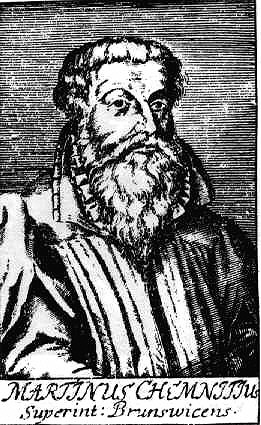
“Chemnitz, the greatest theologian of the Sixteenth
Century”
-- Theodore E. Schmauk
Chemnitz on Rites
and Ceremonies: Confessional Principle, Confessional Practice [RTF]
Return to
the Lutheran Theology Web Site Home Page