How Festivals Are Observed in Our Churches
in the Fear of God
MARTIN CHEMNITZ
(From Examination of the Council of Trent, Part IV [Saint Louis:
Concordia Publishing House, 1986], pp. 436-38.)
 With the superstitions removed, the true and useful festivals of the
ancient church are celebrated among us for church gatherings, with such devotion
and piety that there is no doubt that under the blessing of God piety is kindled
and increased, since the people are taught that the Holy Spirit wants to be
efficacious through the ministry of Word and Sacrament, and that Christ wants to
be in the midst of those who are gathered together in His name (Matt.
18:20).
With the superstitions removed, the true and useful festivals of the
ancient church are celebrated among us for church gatherings, with such devotion
and piety that there is no doubt that under the blessing of God piety is kindled
and increased, since the people are taught that the Holy Spirit wants to be
efficacious through the ministry of Word and Sacrament, and that Christ wants to
be in the midst of those who are gathered together in His name (Matt.
18:20).
To speak in particular of the church at Braunschweig, in the schools
daily exercises of piety have been instituted in such a way that some chapter is
always read to the boys who are gathered there, either from the Old or from the
New Testament, with a brief explanation added. Thereafter every hour a number of
pious hymns are sung. Besides, at a certain hour the scholars go to the church
every day and publicly recite some chapter either from the Scripture or from the
catechism, with pious praying of psalms, responsories, hymns, canticles, and
collects.
The people come together twice every day at a certain hour in the
morning and evening, and after a number of psalms have been chanted, a sermon is
held, with readings distributed in an orderly manner, in part from the Old, in
part from the New Testament. The preaching is always concluded with common
prayers, and with some hymn of thanksgiving. Besides, every week on a certain
day a larger number of people come together for public and solemn supplications
called litanies.
However, on Sundays a multitude of people assemble with great
regularity to sing the praises of the Lord, to hear and meditate upon the Word,
for use of the sacraments, for public prayers, for the gathering of alms, and
for other exercises of piety. The order of the time and of the readings is
arranged in such a way from five o’clock in the evening that, according to the
nature of the household, every member of the family is able to be present at
certain gatherings, and that each is able to hear and learn something according
to his own power of comprehension.
Moreover, solemn festivals about the chief benefits of Christ, and of
the principal points of the heavenly doctrine are celebrated with great devotion
and piety, with explanation of the doctrine, and public praise of the benefits
of God. Thus the feast of the birth of Christ is celebrated in a religious
manner, and in order that the whole doctrine about this article can be set forth
and explained, a three-day period is devoted to this festival, as also to
certain other festivals. On the day of the circumcision the teaching is
explained how Christ was made under the Law, also the topic of Christian liberty
is treated, and there are added reminders about the beginning of the new year.
On the day of the Epiphany there is treated the doctrine of and thanksgiving for
the calling of the Gentiles. On the feast of purification the doctrine is
explained how Christ is the firstborn among many brethren; useful reminders are
given for the benefit of women who have given birth, and the very lovely chant
of Simeon is explained. On this festival, as also on others, the abuses and
superstitions brought in by the papalists are censured and refuted. On the day
of the Bacchanals [the day before the beginning of Lent] the story of the
baptism of Christ is set forth in order that people may be reminded of their
profession, lest they imitate the excesses of the heathen on those days. We keep
the festival of the Annunciation of Mary on account of the article about the
conception of Christ; we celebrate the memory of the institution of the
Eucharist on Maundy Thursday. On Good Friday we celebrate a solemn meditation on
the Lord’s Passion. For the same reason we solemnly celebrate the feast of the
resurrection of Christ, of His ascension, of the sending of the Holy Spirit, and
of the Trinity. We retain the festival of John the Baptizer and of the
Visitation of Mary, because the stories contain very useful teachings. On the
day of Michaelmas the papalist fables and superstitions about the dedication and
invocation of Michael are refuted. However the doctrine of Scripture about the
services of the angels is presented, and thanks is given for the fruits of the
earth received throughout the year. On the days of the apostles the Bible
stories about these men are set forth to the people, and then everyone is
dismissed to the labors of his calling.
Thus, since regular assemblies of the church take place every day,
reminders are also given about other festivals according to the occasion
indicated on the calendar, about which we have true histories containing some
useful teaching. Besides these festivals, the doctrine of true repentance and
the history of the passion is customarily treated during the 40 days of Lent.
Besides, a certain number of days has been set aside during each quarter of the
year for the customary treatment of the catechism. Also, we are not ashamed to
imitate the custom of the ancient church by treating certain readings on the
festival days, as Augustine says in the preface to the Epistle of John: “You
remember that we are accustomed to treat the Gospel of John according to the
order of readings, but because now the observance of saints days has come in
between, on which we must recite certain readings of the Gospel in the church,
which are annual affairs that there is no room for others, the order with which
we began is of necessity a bit interrupted, but not omitted.” The same Augustine
says, Tract. 6, in Johannem: “You know that at an annual festival, after
the Passion of the Lord, the book of the Acts of the Apostles is read aloud in
the church every year.” In Tract. 13 he says that Ps. 21 is read every year
during the final week in the hearing of the whole people.
Concerning the true celebration of the ancient and useful festivals the
papalists have nothing they can deservedly censure in our people. Would that
they themselves would rightly give attention to the godly and devout celebration
of the ancient festivals in such a way that, once the superstitious opinions had
been cast off, they could serve to increase true piety.
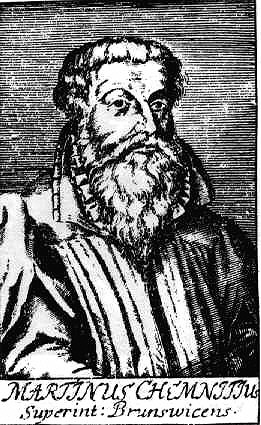
“Chemnitz, the greatest theologian of the Sixteenth
Century”
-- Theodore E. Schmauk
Return to
the Lutheran Theology Web Site Home Page